Circular Economy
What is a Circular Economy?
A circular economy is one that is designed to minimize waste. Products are designed to use as few resources as possible while retaining their function. They are designed to have a longer usable life, to be repairable and reusable, and ultimately, when they are no longer functional. to be recyclable. The diagram below shows how this works, and how it is different than the status quo.
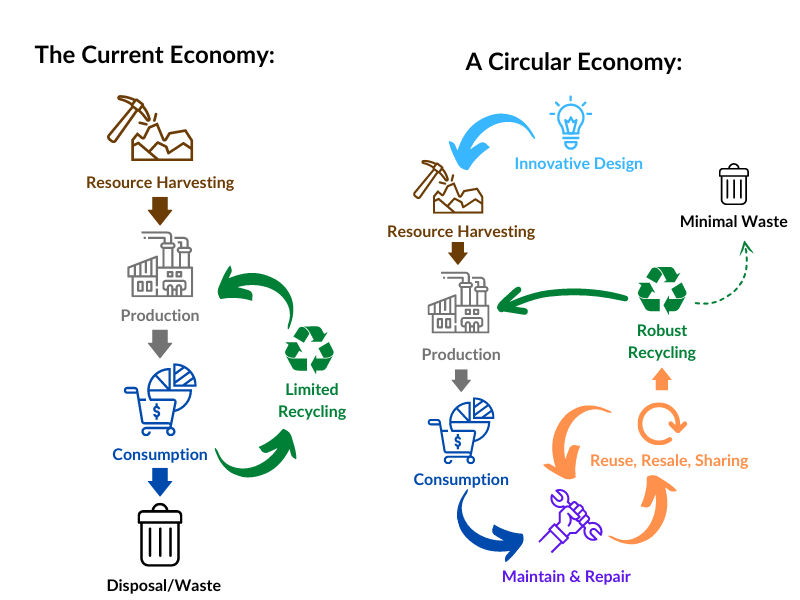
Let's look briefly at each of the special steps that makes a Circular Economy:
Innovative design: All manufactured items and their packaging should be designed strategically to use as few resources as possible. This means favoring resources and components that are easy and safer to obtain over resources that are scarce and require a lot of environmental damage to extract. It also means designing products to be durable so that they last longer, and repairable, meaning it should be possible to replace or even upgrade parts without replacing the entire item. Last but definitely not least, products should be designed to use post-consumer recycled material as much as possible and to be either recyclable or compostable when they reach the end of their useful life.
Maintain & Repair: The average person usually makes a decision about whether to have an item repaired or replaced based on cost alone. If someone gets a flat tire on their new car, there's little question that it will make more financial sense to fix or replace the tire than to buy a whole new car. A shattered screen on a smart phone that's a few generations old is usually a more difficult decision - sure, the screen can be replaced, but if the phone is getting outdated anyway...
The circular economy model asks all of us as consumers to also consider the environmental costs of producing new items and disposing of items that could be repaired. We should also try to think about maintaining our things properly to extend their useful life. Most of us are used to thinking about maintenance for big ticket items like cars, houses and major appliances, but even smaller machines and clothing items need some basic care and maintenance to stay functional for longer.
Reuse, Resale, Sharing: This goes hand-in-hand with maintaining and repairing. If a person maintains and item they own and has parts that break replaced or repaired, they can reuse it over and over again. If they simply don't need or want the item anymore, they can sell it or give it away for someone else to use. Most people are aware of thrift stores and online marketplaces that circulate used and refurbished items. An important step in advancing the circular economy is breaking cultural stigmas around buying second-hand items. Another option, particularly for relatively expensive items that are used infrequently, is to develop a pool of items that are shared with neighbors.
Robust Recycling: While most of us here in Kane County have access to recycling, our actual diversion rates, and indeed, diversion rates around the state and country remain fairly low. According to the most recent data from the U.S. EPA, our national recycling rate is about 32% of potentially recyclable material. Within that large number are a wide variety of rates for individual materials. For example, we do a pretty good job of recycling paper and cardboard (68%) but a fairly poor job of recycling plastic (~8.5%). Improving recycling will involve upgrading the equipment used in automated sorting facilities, developing markets for more materials, and rigorous public education to help people recycle often and recycle right.
Minimal Waste: When all of the above steps are put into place, there should be much less waste material going to landfills.
What can Citizens Do?
Support Policy and Organizations: One of the most important things any citizen can do is to learn about and become involved with any organizations supporting or promoting the activities that make up the "loops" of the circular economy. This can be on a grassroots level, with neighborhood or municipal groups, and on a state or even national level. Citizens may wish to follow green policy proposals as they are introduced to the IL General Assembly or to the U.S. Congress and take individual or collective action to support those bills and encourage their passage.
Support Circular Economy Principles in Day-to-Day Life:
Innovative Design - Look for and buy products with any combination of the features listed below. Keep in mind that these items may not be the cheapest among their competitors but may have greater value over the long term.
- Seek out items that are durable and well-constructed (look at company reputation and item reviews from long-time users)
- Seek out items that come in minimal packaging that is easily recyclable (e.g. paper fiber and metal components are generally preferable to molded, flexible or foam plastics)
- Seek out items that come with repair instructions and for which spare parts are readily available
- Seek out items that are made from and/or packaged with post-consumer recycled materials
- Seek out items that can be recycled at the end of life
Maintain & Repair:
- Keep a hard copy or electronic maintenance log for your things
- When you buy a new item, look at the manual for maintenance recommendations and add it to the log
- Common maintenance items that often get overlooked include:
- Battery inspection and replacement
- Filter inspection and replacement
- Sharpening or replacement of blades
- Other minor component inspection and replacement
- Routine cleaning according to specifications (sometimes requiring disassembly, depending on the item)
- Charging and discharging of infrequently used electronic devices and power supplies
- Routine inspection and tightening of joints, fasteners, etc.
- Lubrication of mechanical parts
- Correct storage to preserve item longevity
- Carefully follow the maintenance schedule developed in your log - not just when an item stops working or has a noticeable performance problem. You might be able to do a lot of the maintenance activities yourself, but be sure to use a trained professional where indicated by the product manual.
- Consider having damaged things repaired, even if you can afford to replace them.
- If you choose to replace a repairable broken item, consider either donating the old, damaged item to an organization that will repair and resell it, or pay to have the old item repaired and then donate it to a thrift store or other charity or resell it directly at a garage sale or online marketplace.
- Support local repair businesses! See this page for our maps of these businesses. We list businesses that repair clothing, shoes and leather accessories, electronics, appliances, and bicycles.
Reuse, Resale, Sharing - Reuse occurs when the original purchaser of an item uses it over and over instead of replacing it. Resale occurs when the original owner sells or donates an unwanted item for use by somebody else.
- Buy things that are timeless rather than trendy so that you will be comfortable using them over a longer period of time
- If there's something that you need to use infrequently, consider renting it instead of buying. Examples include power washers, roto-tillers and edgers, certain types of saws, tree pruners and other power tools, painting equipment, furniture pads for moving, etc.
- Consider initiating a sharing group with your neighbors for expensive items that each family would use relatively infrequently (see examples on last bullet)
- Try thrift or consignment shopping for clothes, furniture and other household items. Thrifting can be especially good for things you won't use often, like Halloween costumes and even formal event attire.
- Sell, share or donate your old things instead of throwing them away.
Robust Recycling
- Avoid buying things that can't be recycled or composted or that come in packaging that can't be recycled or composted. These include items made primarily from plastics #6 (polystyrene) and #7 (other/mystery plastic).
- Follow the guidance elsewhere on the KCR page to recycle everything that can be recycled without "wish-cycling"
- Work with your church or community and neighborhood groups to establish group drop-offs for items that can be recycled can't go in the curbside bin. Examples include styrofoam, electronics, clothing and plastic bags.
Circular Economy Resources
